


Our Research Units
ELAL – Landscape Ecology and Archaeology Lab
The Landscape Ecology and Archaeology Lab (ELAL) investigates long‑term human–environment relationships across diverse past landscapes. It integrates material culture studies, environmental reconstructions, ecological perspectives, and advanced digital methods to understand how people shaped and responded to changing worlds.

Into the Desert Research Group
Into the Desert focuses on Neolithic communities in the varied arid environments of the Negev, exploring how they organised settlement, mobility, and land use under extreme conditions. The group studies resilience and long‑term sustainability in harsh desert landscapes.

BGU_DARC – Digital Archaeology Unit
BGU_DARC develops and applies digital methods for archaeological research, including drone-based survey, LiDAR, thermal imagery, photogrammetry, and GIS. It provides the spatial and remote‑sensing backbone for ELAL and its research groups, supporting field projects and student work across regions and periods.

See our current projects
 |
The Neolithic of the Near East was a period of fundamental changes in human social and economic strategies. In the Mediterranean zone, these changes included the emergence of large sedentary villages, plant cultivation and animal husbandry. In the arid zones on the other hand, processes were in general more prolonged, and subsistence remained largely based on hunting and gathering until late into the period. The deserts of the Near East are nevertheless vast and varied, and when we take a closer look into specific regions and sub-regions within them, a much wider range of local adaptations can be discerned, both socially and culturally, as well as economically. Yet, while the Neolithic of the Mediterranean zones of the southern Levant is quite well-studied, our knowledge of the contemporaneous occupation of the deserts is limited. This is especially true for the southern Negev desert. |
| Located in southern Israel, the southern Negev is a hyper-arid region, exhibiting extreme environmental conditions. Still, human exploitation of this region has been persistent, almost uninterrupted over millennia. Within the southern Negev, the Uvda valley (Biq’at Uvda) represents a well-defined sub-region, both geographically and ecologically. Extensive surveys and excavations during the 1970s and 1980s have revealed substantial exploitation of the valley during the Early Neolithic (ca. 8600-6400 calBC) but have remained largely unpublished. Through the re-examination of the key-site of Nahal Issaron, and the excavation of two more sites (Ein Qtura and Nahal Reu’el), |  |
 |
this project wishes to explore in a systemic manner the Early Neolithic exploitation of the extreme, hyper-arid environment of the southern Negev desert, as manifested in the Uvda valley. Bringing together archaeological, geomorphological and paleoenvironmental methods, we wish to understand how Neolithic populations made use of this harsh environment and how they organized their activities within it. |
| The Uvda valley, with its surprisingly rich and diverse evidence for Early Neolithic activity, presents a natural laboratory to test these modes of adaptation. Located in a pivotal point, connecting the vast deserts of the Near East with those of North Africa, and the Mediterranean region to the north, it has the potential of elucidating important issues such as settlement strategies, cultural transmission, and the exchange or trade of concepts, materials, and goods. Thus, it will supplement our models of Neolithization strategies, processes and dynamics in the Mediterranean zone with invaluable knowledge of the contemporary desert occupations, enhancing the southern Levantine narrative of the ‘Neolithic Revolution’. | |
The project is funded by the Israel Science Foundation (grant #351/21)
 |
The site of Naḥal Issaron is located in Biq'at Uvda, a large planar valley ca. 35 km north of the Gulf of Eilat and ca. 5 km west of the ‘Arabah Rift Valley. It was discovered in 1980 during the Emergency Archaeological Survey of the Negev, and subsequently excavated in 1980-1981 (Gopher et al. 1994; Goring-Morris and Gopher 1983). A complex stratigraphic sequence was recorded, comprising both Pre-Pottery and Pottery Neolithic occupations, as well as a later, more ephemeral, Early Bronze Age stratum. The principal phase of occupation was dated by 14C to ca. 8500-6500 calBC, after which the site continued to be occupied sporadically until ca. 4500 calBC, or shortly thereafter (Carmi et al. 1994). |
| The Pre-Pottery Neolithic layer (Layer C) was surprisingly rich and included complex ‘bee-hive’ architecture, a variety of storage and combustion installations, and a unique repertoire of small finds, including shell, bone and stone artefacts. Most impressive was the exceptional preservation of organic material, including faunal remains, which to date remain unparalleled in the region (Carmi et al. 1994; Goring-Morris and Gopher 1983; Gopher et al. 1994). | 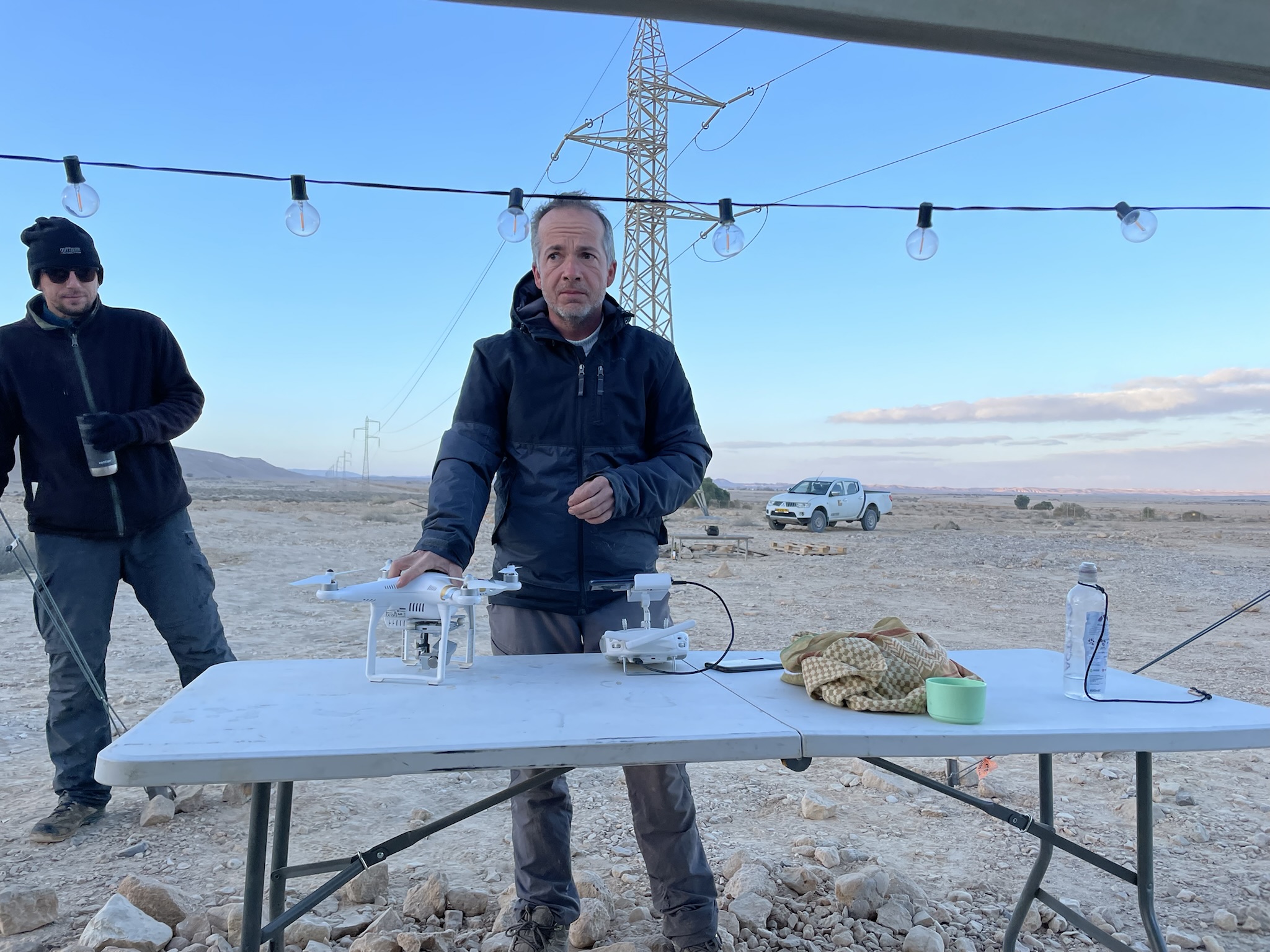 |
 |
The renewed excavation project at Nahal Issaron is part of the ISF-funded project titled “Into the Desert: Biq’at Uvda and the Early Neolithic of the hyper-arid Negev desert” (grant #351/21). It also received a generous dedicated grant from the Gerda Henkel Stiftung (grant # AZ 38/V/20). |
 |
Located on the uppermost reaches of the Roded mountain, ca. 5 km north-west from the city of Eilat, the site of Nahal Roded 110 (NR110) is a unique hunting locale that specialized in hunting raptors. Both radiocarbon and optically stimulated luminescence date the site to the Late Pre-Pottery Neolithic B (LPPNB, late 8thmillennium BC) |
| Palaeoenvironmental data from pollen and charcoal indicate that arid conditions prevailed in the region during the site’s exploitation, with a strong Saharo-Arabian influence. The finds—flint tools, marine shells and other stone objects— show affinities to LPPNB settlement sites in the region, and reflect a variety of activities performed on site, such as flint knapping and bead making. | 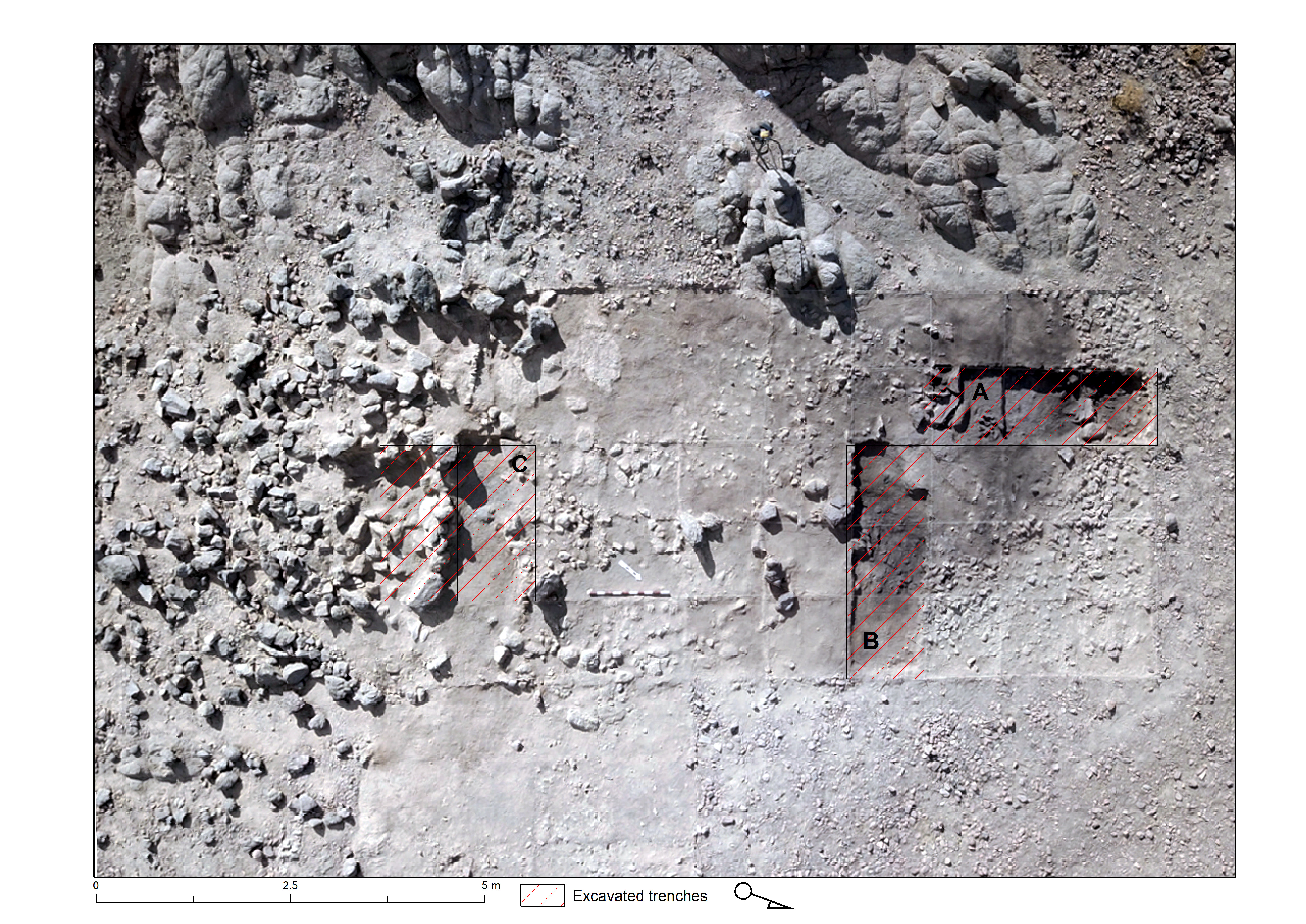 |
 |
The faunal assemblage is unique and comprised solely of raptors. in the Neolithic of the Near East, birds of prey appear to have played an important symbolic role in iconography and archaeozoology at least since the Pre-Pottery Neolithic A. Related finds in Neolithic sites are usually comprised of few, scattered remains of talons or isolated bones. |
This project is funded by a generous grant from the Irine Levi-Sala CARE Foundation.
|
installations, as well as a rich lithic assemblage. |
Co-PI: Talia Abulafia (The Israel Antiquities Authority). The site of Nahal Zahal is located in Ramat Hovav (northern Negev). It is situated on the southern bank of the Nahal Zahal wadi, a small tributary of Nahal Sekher. A salvage excavation, carried out in March 2020, revealed an Early Pre-Pottery Neolithic B occupation (EPPNB; ca. 8600-8150 calBC), comprising at least one large, round structure with adjoining cells and |
 |
The site of Nahal Zahal provides an important opportunity to explore EPPNB dynamics in the arid Negev. The complex architecture exposed in the salvage excavation and the range of activities conducted, as implied by the small finds and installations, will enable a discussion of EPPNB ways of life. The unique preservation of organic material presents an exceptional chance to radiometrically date the occupation at the site and the EPPNB of the Negev in general. This project is funded by a generous grant from the Irine Levi-Sala CARE Foundation. |

| This project, conducted in collaboration with Prof. Lev Eppelbaum and Dr. Olga Khabarova (Tel-Aviv University) proposes a novel, integrated methodology for archaeological surveying, site detection, and analysis, based on the assimilation of archaeological methods, advanced remote sensing, ground-based geophysical reconnaissance, and machine learning technologies. Traditional pedestrian surveys, while invaluable, are at times limited by time, cost, and accessibility challenges. This project seeks to address these limitations by leveraging state-of-the-art remote sensing tools, such as high-resolution satellite, aerial, and thermal imagery, alongside geophysical techniques like ground-penetrating radar (GPR) and magnetometry, into an archaeological framework. |
 |
| The research focuses on the hyper-arid Negev Desert, a region offering diverse environmental challenges alongside high archaeological potential, testing and refining the integrated approach in three case-study areas – Mt. Roded, Biqat Uvda, and the Eastern Paran Basin. | |
| The expected outcomes include the development of a repeatable and scalable pipeline for archaeological site detection and analysis in complex environments, the identification and documentation of new and existing sites, and the creation of a publicly accessible digital catalog of archaeological data, contributing to the preservation of cultural heritage while advancing archaeological methodologies. This research represents a significant step forward in digital archaeology, offering scalable solutions to pressing challenges in archaeological survey and analysis. It will also contribute to the development of preservation of cultural heritage in Israel and beyond. |
 |
